

Independence is your license to tell the truth. Most operators never use it.
In May I told you to set a floor on what you charge and hold it. Know your number, charge for the kickoff, walk away from the client who negotiates you down before he has asked a single question about scope.
That half of the job is not easy, but it’s easier than the half that happens after you get the signature.
Let me tell you about Steve.
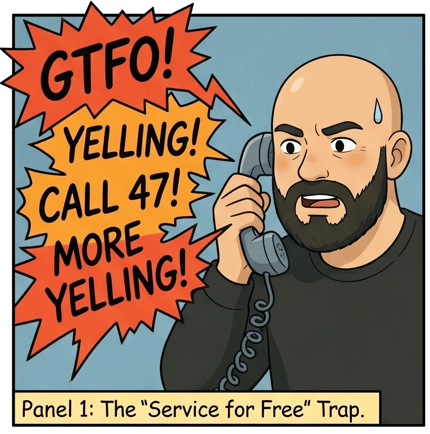
A client once spent 2 months yelling at me over the phone.
This was real yelling, real anger. For years I had given him a service for free, and when we finally decided to start charging for it, I needed to tell him. I told him long before his next budget cycle but it did not matter. He only cared that the free thing was no longer free, and he let me know it on call after call after call.
While he was mid-rant I recognized that his anger was the best proof of value I could have asked for. Nobody screams about losing something they did not need and knowing that did not make the calls any shorter.
He argued, he escalated, he tried every angle to keep the thing he had always gotten for nothing, and I sat there absorbing it, being reasonable, explaining the rationale one more time, doing everything a level-headed operator is supposed to do. But, the reasonable explanations did not work. They just added fuel to his fire.
A few days before he had to sign the new paperwork he was still going. I'd had enough, and I stopped him in the middle of a big rant and said, "Steve, you know, you get more flies with honey."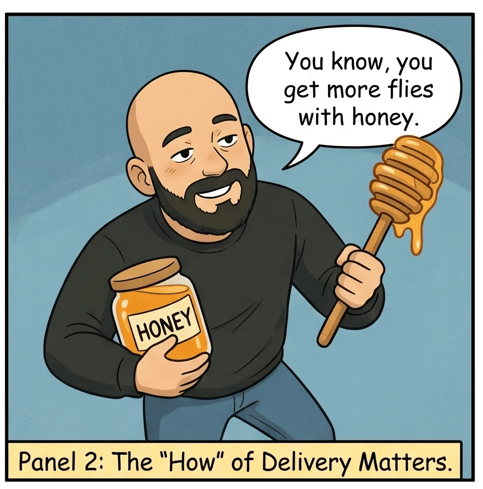
Then nothing. Silence for what felt like days. I wasn't sure if he was about to go absolutely postal and if I had just made a huge mistake.
Then he simply said, "Okay Neil, let me call you back."
He called the next day, apologized, and signed.
From that point on the relationship was better than it had ever been, as if one sentence had held up a mirror and he did not love what he saw in it.
Here is the lesson. Two months of better arguments got me nowhere. One line, delivered at the right moment in a tone that disarmed him instead of matching his heat, got me the signature and a better relationship on the other side of it. Same underlying message I had been pushing the entire time. The delivery is what moved him.
Warmth and directness in the same breath.
Softer Is Not Better. It Is Just Softer.
The going wisdom right now is to soften everything and make it about the buyer. That advice is not necessarily wrong, but softer is not always better. It’s just softer. HOW is what matters. HOW you say things in sales matters just as much as what you say. Tone, timing, pauses, framing, they are all invisible cues that change how people feel, and feeling drives decisions.
- "We help companies like yours" becomes "Here's what we've done with teams similar to yours." One sounds like a pitch. The other sounds like proof.
- "Our solution is best-in-class" becomes "This might be a strong fit based on what you've shared." One is self-serving. The other is buyer-aligned.
- "What's keeping you from buying?" becomes "What might be getting in the way of moving forward?" One feels accusatory. The other feels collaborative.
A lot of what passes for consultative right now is just hedging with a nicer vocabulary. The tell is what the softness is anchored to. "This might be a strong fit based on what you've shared" ties the soft language to something the buyer actually said. "This might possibly be a fit, depending on how you feel about it" ties it to nothing but their mood, and that is a scared seller. It reads buyer-friendly and it lands weakly. Permission-seeking language lowers your status in the room, and a client can smell a low-status operator the same way they can smell a desperate one.
Now run my call with Steve through that lens. Softer is the opposite of what I did. I got more direct. The honey line was a confident, slightly cheeky reframe that named his behavior without attacking him.
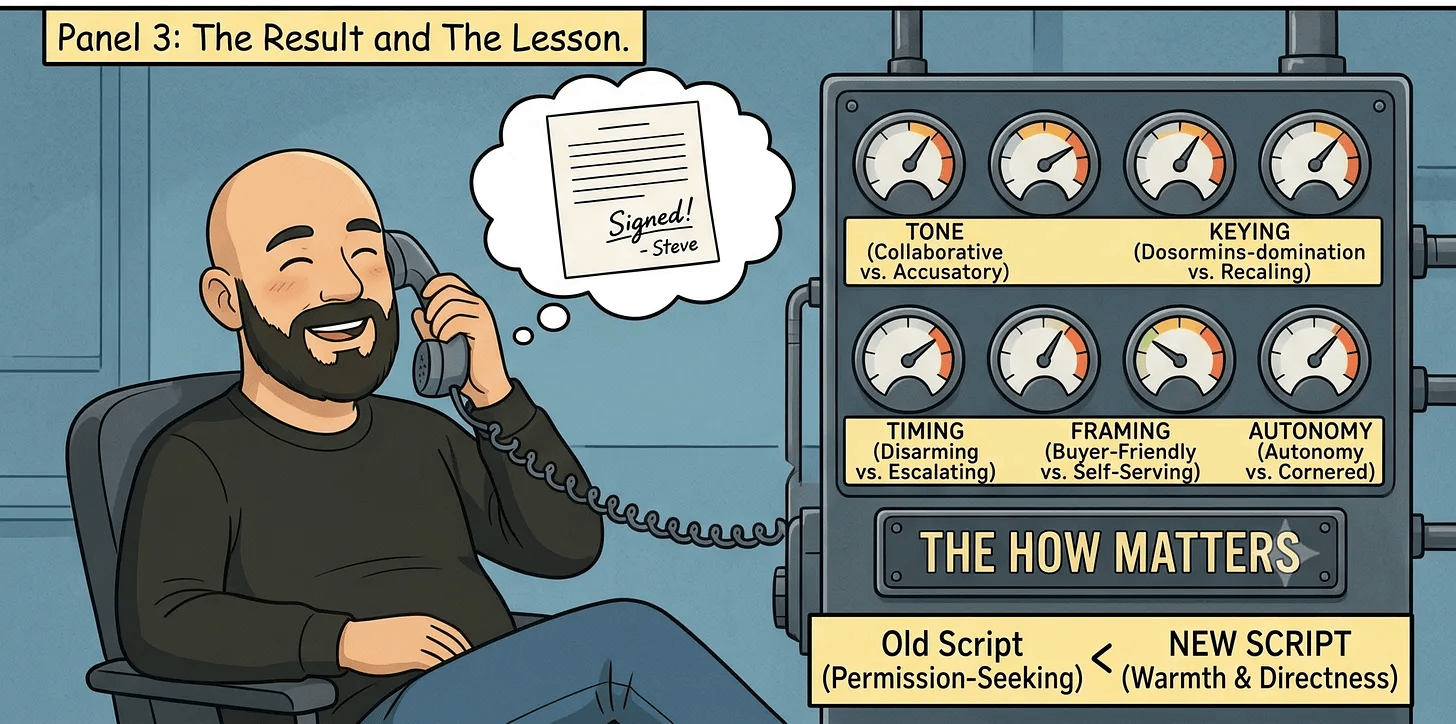
So do this. Say the true thing, but engineer how it lands. Pick the HOW that lets the buyer shine, then say it with enough conviction that you show no doubt (respect and certainty at the same time).
When the HOW respects them and still carries the confident truth…resistance drops and deals move forward.
Anybody can copy the script off a LinkedIn carousel. How you deliver it under pressure, with a client screaming on the other end of the line, is the part that took me too many years and one old line about flies and honey to finally understand.
Sit With This a Bit.
Anybody can sell a client days on a calendar. What the client is actually buying is a person who has no promotion to protect, no internal enemy to manage, and no reason to tell them anything other than what is true. That is the entire product. That is what they are buying your expertise and the blunt truth.
So when you soften the diagnosis to protect the relationship, you should be fired.
I have watched excellent operators spend years being agreeable, and it did not make the clients love them more. It made the clients keep them around and stop listening to them, which is a slower and more humiliating way to lose the account in the long run.
Say the truth with enough conviction that the client sees no doubt in you, and enough warmth that they can hear it without going to war.
In May I told you to charge what the work is worth. Now go be worth it.
See you next month with another unfiltered dispatch from independent operator life.
Meet Neil...
Neil Weitzman is a longtime Pavilion Ambassador and the co-leader of our CAF (Consultant, Advisor, Fractional) sub-community. A seasoned fractional CRO and GTM operator. Neil brings tactical wisdom and unfiltered insights to help independent executives thrive. This article is part of The Independent Operator, Neil’s ongoing series for Pavilion.
Connect with Neil on LinkedIn | Linktree | Follow his GTM or GTMFO Substack or learn more at weitzmangtm.com