

Welcome to The Independent Operator, a blog series from Pavilion featuring insights for GTM leaders navigating fractional and advisory work.
Meet Neil...
Neil Weitzman is a longtime Pavilion Ambassador and the co-leader of our CAF (Consultant, Advisor, Fractional) sub-community. A seasoned fractional CRO and GTM operator. Neil brings tactical wisdom and unfiltered insights to help independent executives thrive. This article is part of The Independent Operator, Neil’s ongoing series for Pavilion.
Connect with Neil on LinkedIn | Linktree | Follow his GTM or GTMFO Substack or learn more at weitzmangtm.com
Every week, I get some version of the same message. A full-time CRO reaches out, and the question is always some version of "How did you make the jump?"
So many are tired, frustrated, and burned out from fighting the same battles every quarter, or they got laid off due to AI and it was an awakening of what they should have seen but never did until they had a moment to breathe.
Many CROs and CMOs are still making the move to independent operator work or considering it strongly. For those of us already in the fractional world, it changes the game whether we like it or not.
Before we dive into this, let’s slow our roll, we need to make sure we are actually talking about the same thing.
Full-Time In-Seat Operator vs. Part-time/Fractional In-Seat Operators vs Consultants
No matter how many times we define it, when most people hear "fractional CRO," they picture an advisor or traditional consultant.
Someone who shows up to a monthly call, reviews the pipeline numbers, offers a few observations, and sends a recap email. Someone who gives advice only and a slick template. Or, someone who has a scope of work and set deliverables and if you ask them to do anything else they say let me adjust the scope of work and charge you an additional $10k. Those are advisors and consultants.
Those are legitimate engagement models and they both serve a purpose. But it is not what a Fractional CRO does, at least not the good ones that I know.
What I am about to say, many people will disagree with (story of my life). But this is how I see it. This is the world I live in.
This is how I define a full-time in-seat CRO vs a Fractional CRO vs a GTM Advisor or Consultant.
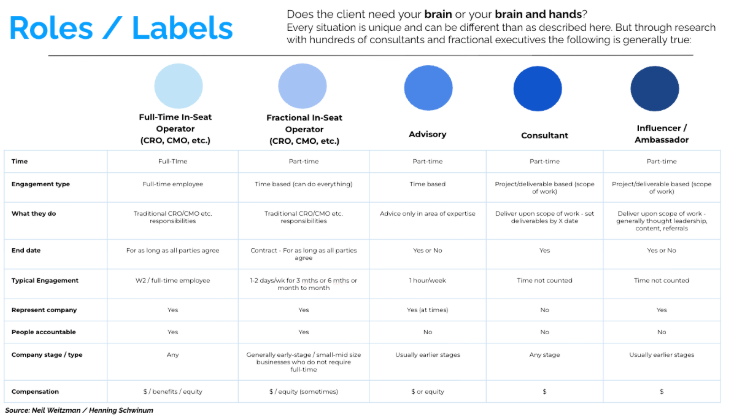
An in-seat fractional CRO is doing the job. Attending the team meetings, running forecast calls, coaching reps, building playbooks, getting on calls with prospects when it matters. The only difference between that and a full-time CRO is the number of days per week on the clock. The work is real, the accountability is real, and the hands are dirty either way.
For an early-stage company, that distinction matters enormously. A 20-person SaaS company with a three-person sales team does not necessarily need a full-time expensive CRO. The role does not exist at that scale in a way that justifies the cost or the headcount. But they absolutely would benefit from someone who has built this before, someone who can set up the foundations elements of an elite GTM process. The qualification process, the pipeline structure, the hiring profile, the comp philosophy, the messaging and so on. And make sure those foundations are right before the company even begins to utter the word “scale”.
Getting that wrong early is expensive as hell and takes a long time to get out from under.
The fractional CRO model solves that problem. You get the operator, in the seat, doing the work, without the full-time price tag that the stage of the company cannot yet support.
But here is the part that I really love. And I love saying this. My job is to put myself out of a job.
A good fractional CRO should be working toward their own irrelevance. The job is to build it, staff it, and hand it off when it justifies a full-time leader. The fractional operator's single most important deliverable is leaving the function in a state where a full-time leader can walk in, understand exactly what exists and why, and accelerate from there.
That transition, done well, is one of the most valuable things an experienced operator can deliver. Done poorly, or not planned for at all, it is how companies end up rebuilding the same foundation twice.
Why Some Great Full-Time CROs Are Jumping
I was a full-time executive for a long time. I loved it, until the cons started to outweigh the pros in a way I could not ignore. That calculation is different for everyone, and only you can decide what it is worth to you.
That said, anyone who has held a full-time CRO or CMO seat can list the frustrations without thinking very hard. Targets set by gut feel rather than data. Headcount cut in half while the number doubles. A product roadmap driven by what the CEO believes rather than what customers are asking for. Comp plans that reward the wrong behaviors. Attribution debates that never get resolved. AI moving fast enough to reshape expectations while human behavior changes at its own slower pace.
With AI some of these things are not as crazy sounding as they used to be and there are CRO’s out there crushing it. But the average CRO tenure is still less than 2 years and CMO’s are not much better. That is barely enough time to understand the business, let alone transform it.
I Love Being a fCRO But I Hate These Things
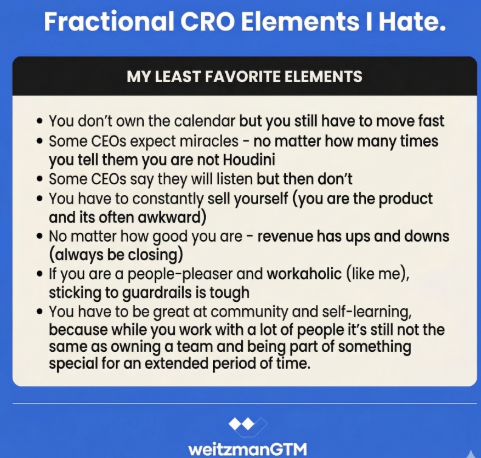
It’s not all chocolate and rainbows. I love being a Fractional CRO. I am 53 and this is the most fun I have ever had in my career. I learn more, I teach more, I laugh more and I make more money. I spend a lot of time talking about all the things I love. But I don’t want anyone to ever say I didn’t warn you. So here are the things that nobody warns you about - the things I hate can be seen here.
A Rising Tide
More people going independent is a good thing for the ecosystem. Full stop. More companies get access to experienced operators they could not afford full-time. The quality of fractional work improves as the talent pool deepens. The stigma around non-traditional career paths keeps fading. All of that is worth celebrating.
But it also means more competition and that means the bar is going up and none of us get a pass for having arrived early.
We have to keep showing up and keep earning it. The days when "fractional CRO" on a LinkedIn headline was enough to get meetings are gone. CEOs are doing their homework. They are getting referrals. They are learning to tell the difference between a consultant and a true in-seat fractional operator, and they can spot someone who has never actually been a fCRO but is billing themselves as though they have.
For the fractional operators who want to lead in this environment, a few things matter more than ever. Your reputation has to be bulletproof because referrals are our bread and butter. You need a clear lane because if you cannot say it in one sentence, the market will never say it for you. Community and kindness matters more than ever because this is a long game and the people you help today become the people who refer you tomorrow.
For the full-time CROs or CMOs wondering if the jump is right for them: Going fractional is not running away from the grind - it is simply about choosing a different grind, one that you might actually enjoy more. It requires a different kind of grit and some different skills.
It’s not right for everyone.
But you never liked pizza till you tried it.